
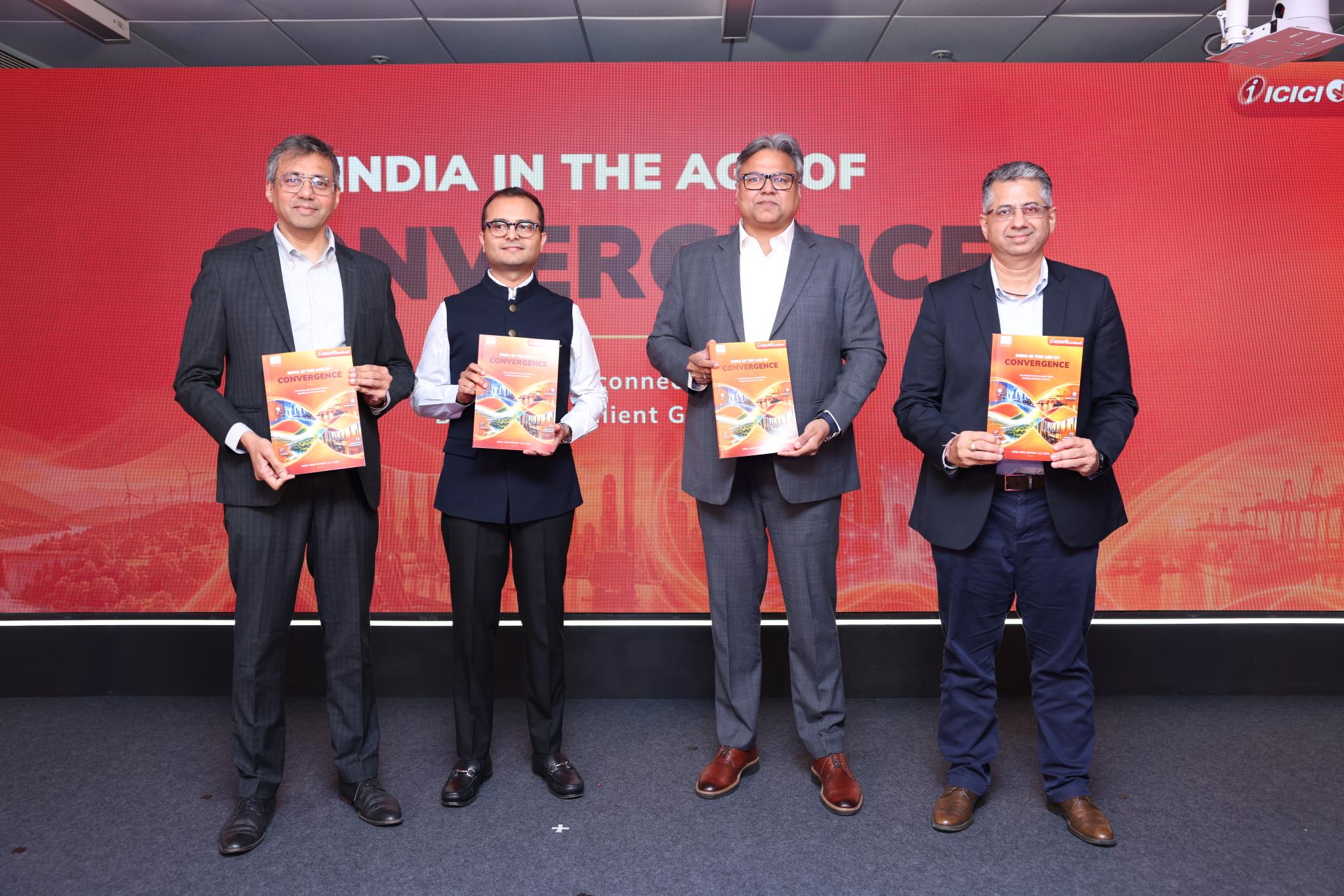
Delhi, November 23, 2026: ICICI Lombard and Institute of Risk Management (IRM) India Affiliate unveil the fourth edition of the India Risk Report, examining how the convergence of Technology/AI, Geopolitics and Climate Change is reshaping the risk landscape for Indian businesses. The report highlights how these forces increasingly interact, creating business pressures that can cascade across operations, supply chains and financial performance. It also underscores the importance of Governance Quality in determining the severity of these interconnected risks and an organisation’s ability to respond to them.
Based on the Enterprise Risk Perception Survey 2026, which received responses from 253 organisations across sectors, the study assesses risk perceptions, AI adoption and preparedness, risk-management maturity, insurance practices and emerging exposures. It also examines how insurance solutions need to evolve to address this changing environment. The report identifies Cyber Risks as the leading short-term concern and Technology/AI as the top long-term risk. Climate Change has entered the top three long-term risks for the first time, while geopolitical and trade-related uncertainties are testing organisational preparedness.
Reflecting the evolving need for innovative risk-transfer solutions, ICICI Lombard has introduced its enhanced Parametric Insurance Solutions, designed around more than 18 measurable parameters, including rainfall, temperature, humidity, cyclones, floods, air quality and solar irradiation. The solutions provide pre-agreed payouts when specified thresholds are breached, enabling faster financial relief without relying on conventional physical loss assessments or survey-led claims processes. With policy tenures of up to five years, they are designed to address financial impacts such as loss of income, revenue disruption, asset impact and increased expenditure. The solutions cater to key sectors including Renewable Energy, Financial Institutions, Agri & Allied Enterprises, and Gig-Based Enterprises, helping businesses build resilience against increasing climate and weather-related uncertainties.
Complementing these solutions is ICICI Lombard-ANTRIKSH (Applied Network for Targeted Risk Insights in Krishi & Spatial Hazards), ICICI Lombard's advanced risk intelligence platform that harnesses satellite imagery, geospatial analytics, weather science and climate modelling to transform complex environmental data into actionable insights. Built to support data-driven resilience, ANTRIKSH enables businesses, institutions and communities to better understand, anticipate and manage emerging risks through scientifically validated, location-specific intelligence, strengthening informed decision-making in an increasingly dynamic risk landscape.
Anand Singhi, Chief – Corporate, International, Banca (KRG) & Government Business, ICICI Lombard, said, "Resilience is no longer defined by how businesses recover from disruption, but by how effectively they anticipate and prepare for it. As climate volatility and other emerging risks continue to intensify, organizations require solutions that combine data, technology, and risk-transfer capabilities to navigate uncertainty with confidence. At ICICI Lombard, we are addressing this need through the launch of our Parametric Insurance Solutions for Corporates, which provide faster and more transparent financial protection through predefined triggers linked to measurable parameters. We are also introducing ICICI Lombard-ANTRIKSH, a first-of-its-kind platform that harnesses geospatial intelligence and advanced analytics to generate actionable risk insights across climate, agriculture, and spatial hazards. Our partnership with the IRM India Affiliate further strengthens this endeavour by fostering greater awareness and understanding of evolving risks and resilience strategies."
Hersh Shah, CEO, IRM India Affiliate and India’s Youngest Enterprise Risk Expert, said, “The real test of enterprise risk management is not how many risks an organisation can identify, but how effectively it can respond to them. Businesses are operating in an environment where technology, geopolitical developments and climate-related disruptions can create consequences across multiple functions. Yet, preparedness does not always keep pace with the recognition of these risks. Governance is central to closing this gap. It establishes who owns a risk, how decisions are made and whether organisations are equipped to act before an exposure escalates. Risk management must therefore be embedded in business strategy and everyday decision-making, rather than treated as a separate compliance function.”
The study identifies the following key trends in enterprise risk perception, preparedness and risk-management practices:
1. Cyber risks remain persistent, while AI is reshaping the risk outlook: Cyber Risks have retained the top position in the short-term risk rankings across all four editions of the survey since 2023 and have remained among the top two long-term risks. Technology/AI has moved to second place in the short-term rankings in 2026 and ranks first among long-term risks. Information Risk emerges as the leading concern associated with AI adoption, while Operational Efficiency is identified as its biggest opportunity, receiving 55.1% of Rank 1 votes. The findings underline the need to balance the opportunities from AI adoption with appropriate safeguards, data protection and board-level oversight.
2. Preparedness is uneven across established and emerging risks: Organisations report stronger readiness for familiar risks such as Legal/Regulatory, Cyber and Fire/Explosions, but preparedness is weaker for Climate Change, Trade War/Global Trade Realignment and Civil Strife/Geopolitical Issues. Only 29% of respondents have both a strategy and the capabilities to manage geopolitical risks, while the corresponding figure for trade realignment is 31%. The findings point to a gap between recognising emerging exposures and building the capabilities to manage them.
3. Risk management and insurance practices need to evolve: The survey finds that 34.6% of organisations use a combination of insurance and non-insurance solutions, while 16.1% report having no risk-management solution. The protection gap is particularly visible in emerging risks: 25.3% report no solution for Trade War/Global Trade Realignment and 21.7% for Climate Change. Respondents also expect insurers to provide support beyond traditional cover, with risk benchmarking and claims analysis emerging as the most sought-after services, both at 72.3%.
4. Governance and organisational maturity will shape resilience: Governance Quality records the highest mean influence score at 2.37, marginally ahead of AI/Technology at 2.36. The report highlights its role in setting accountability, strengthening controls and managing the consequences of external disruptions. It also finds that 58% of organisations are at the Progressing stage of risk-management maturity and 33% at the Transforming stage, indicating that while risk practices are developing, embedding them consistently across organisations remains important.
5. Midsize enterprises face additional preparedness challenges: The report’s focused assessment of 88 midsize enterprises highlights distinct vulnerabilities. Talent Risk features among their top five short-term concerns, while Climate Change and Technology/AI present notable exposure gaps. Around one-third of midsize respondents report having no risk-management solution for Climate Change, underlining the need to strengthen both organisational capabilities and access to appropriate risk-transfer solutions.
As risks become more interconnected, organisations will need to move beyond managing individual exposures towards an integrated approach to enterprise risk management. Strengthening governance, improving preparedness and combining mitigation, business continuity and appropriate risk-transfer solutions will be essential for Indian businesses to navigate uncertainty and build long-term resilience.
The report is available for download:
Further reinforcing its commitment to advancing risk management excellence in India, ICICI Lombard launched ‘The Invisible Foundation’ Coffee Table Book, a landmark publication that chronicles the evolution of the risk profession and showcases the contributions of leading risk practitioners. The book brings together industry perspectives, success stories and thought leadership, serving as both a tribute to the risk managementernity and a valuable resource for professionals navigating an increasingly interconnected risk landscape.