
Berlin / Paris, Nov18: In September 2026, Alpha Impulsion, CT Ingénierie, and Mecano ID announced the formation of the 2030+ European alliance to develop the GARNET rocket engine and lay the groundwork for a competitive launch service in the early 2030s.
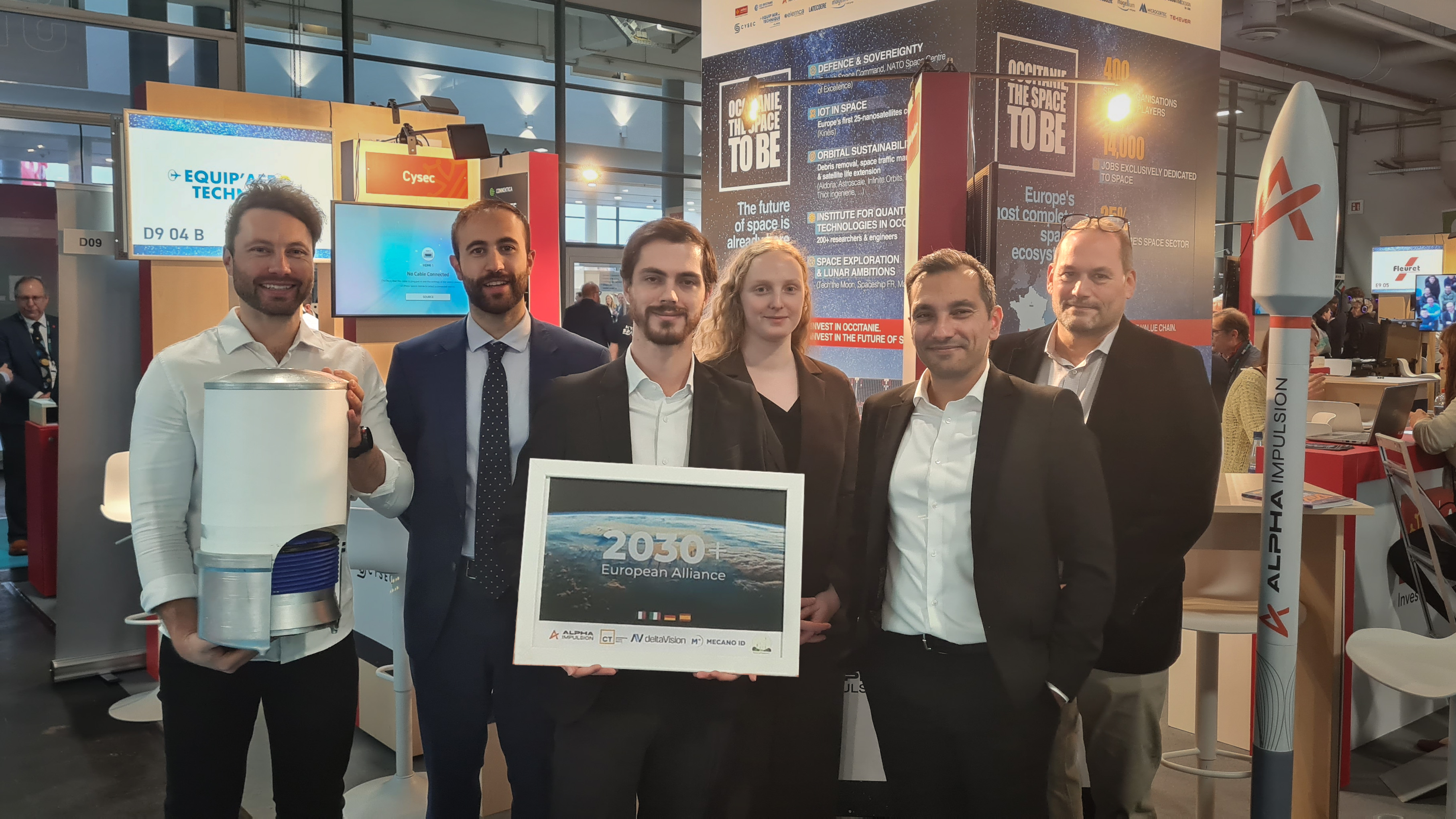
From Space Tech Expo Europe, deltaVision & SpaceDreamS are announcing their participation in the industrial alliance. The companies bring existing valve and fluid handling systems, electric motor expertise and ground test infrastructure to strengthen its path towards a full-engine hot-fire test in 2029.
The 150 kN autophage GARNET engine is designed to support a European micro-launch service capable of placing satellites weighing up to 500 kg into orbit with a target cost of $4,600 per kilogram of payload (a sixth of current micro-launchers' prices). The ambition is to provide satellite operators with a competitive European option for dedicated access to space. A “tailor-made service” complementing rideshare delivery on larger launchers.
This cost target is made possible by its autophage architecture, in which the rocket's fuselage is progressively consumed as fuel during flight. By using the vehicle's structure as propellant rather than discarding it as deadweight, this approach improves mass efficiency and has the potential to reduce launch cost by 80%.
A pragmatic approach to European launch capabilities
Rather than developing every component and capability from scratch, the alliance aims to build on technologies, products and expertise already available within its member companies. This approach is designed to avoid unnecessary redevelopment and limit cost.
The programme already builds on capabilities from its founding members. CT Ingénierie brings 40 years of expertise both in space system engineering and multiphysics modelling under cryogenic conditions. The companie also draws on CPS_C, its
proprietary software for strongly coupled flow and thermal simulations, used to design the autophage insertion system together with Mecano ID. Mecano ID also contributes with its strong structure & fairing manufacturing capabilities.
deltaVision provides all the engine’s valves and fluidic equipment from their existing range of off-the-shelf systems. The company also builds on its knowledge of space rated electric motors, to develop the 70kW motor driving the combustible-fuselage insertion, a key system of the autophage architecture.
SpaceDreamS brings its TestPad and NuPad designs to the programme, providing standardized ground support equipment for full-scale engine testing. Its scope includes the design, manufacture, integration, and operation of the physical test bench and its digital twin, as well as the specialised ground equipment required to handle liquid oxygen. SpaceDreams also assesses potential test site locations based on the availability of existing infrastructure and resources, as well as compatibility with its own systems.
“New European space programmes shouldn’t try to develop every capability in-house. To industrialise space, we need to build resilient supply chains. This will foster standardisation, lower costs and lead times, and benefit every single stakeholder. With our extensive portfolio of valves and electric motors, we are well positioned to address the challenges of the GARNET rocket engine and beyond.” - Alex Plebuch, CEO, deltaVision
“A rocket spends most of its life on the ground. The flight itself lasts a few minutes, but it comes after years of testing and preparation. Standardised, industrialised test and launch facilities can shorten time to launch, lower costs and keep those facilities in use far more of the time. We are designing the test facilities around Alpha Impulsion’s autophage engine drawing on our experience of test benches and launch pads” - Christian Canart, CEO, SpaceDreamS.